Or: I went to YouTube to learn about cloud architecture and came back a different person
Harish Sundaram · April 2026 · 8 min read
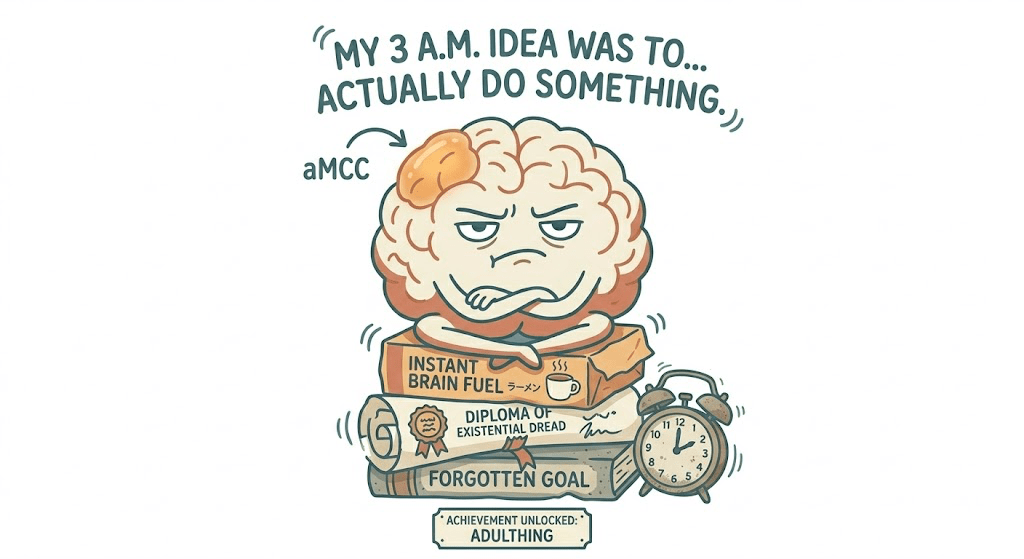
I was watching a video about cloud architecture at 11am on a Tuesday. Perfectly normal. Productive, even.
Then YouTube, being YouTube, quietly placed a Huberman Lab thumbnail next to it. Andrew Huberman. David Goggins. Something about willpower.
I did not click it immediately. I want that on the record.
I clicked it about eight minutes later.
If you do not know David Goggins, he is a retired Navy SEAL and ultramarathon runner who once ran 100 miles on broken feet and then wrote a book about why that was the right call. He is the kind of person whose Wikipedia page makes you feel like you need to lie down. I was not sure why I was watching this instead of working. But I kept watching.
Then, about forty minutes in, Andrew Huberman — a neuroscientist at Stanford who speaks with the calm certainty of someone who has never missed a workout in his life — leaned forward and said something that made me physically pause the video.
He said: there is a part of your brain that physically grows when you do something you do not want to do.
I rewound it. Watched it again.
Then I opened seven tabs.
The organ nobody told you about
The thing Huberman was describing has a name. It is called the Anterior Mid-Cingulate Cortex, and scientists named it the way the government names tax filing categories — efficiently, joylessly, with zero concern for how it sounds out loud.
The aMCC (because I will not type that full name again) is a small structure buried in the middle of your brain. It has been studied since the early 2000s, but it is only in the last few years that researchers started understanding what it is actually for.
What it is for is this: it grows — physically, measurably, on a brain scan — when you do something you genuinely do not want to do.
Not something difficult. Not something that requires effort. Something you specifically, personally, would rather not do. The gap between “I really don’t want to” and “I’m doing it anyway” — that exact gap is the fuel this thing runs on.
Think of it as a GPU that only activates under one very specific load condition. And the load condition is: doing the thing you hate.
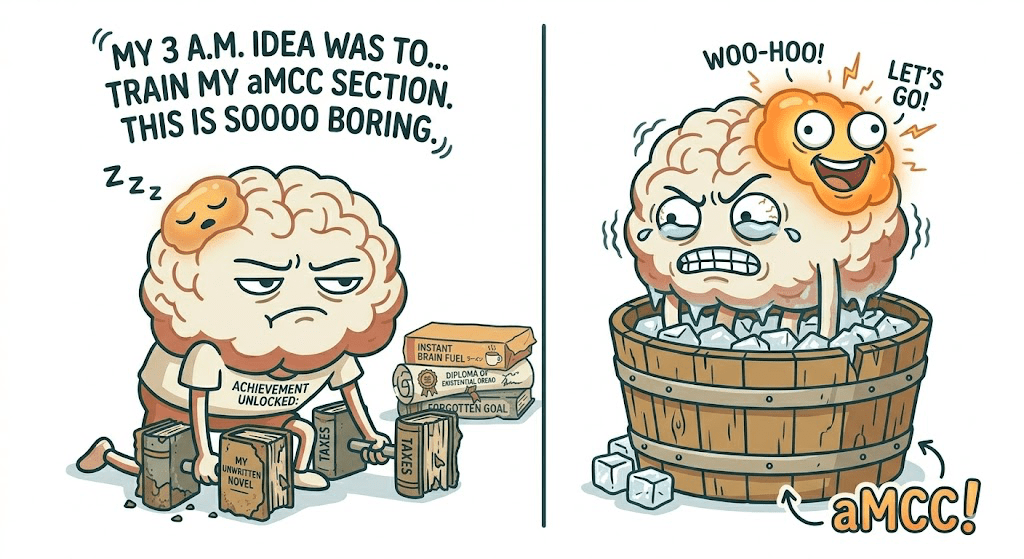
I am sorry.
The data that got personal very quickly
A research team at Harvard and Massachusetts General Hospital, led by neuroscientist Lisa Feldman Barrett, published a landmark paper in the journal Cortex establishing what the aMCC actually does. The findings are, to put it gently, uncomfortable:
- The aMCC is smaller in obese individuals — and grows when they diet
- It is larger in athletes
- It grows significantly in people who face challenges they did not think they could survive, and got through anyway
- And it stays large in people who live exceptionally long lives
That last one sent me to another tab.
A 2016 study in the Journal of Neuroscience identified a group they called “superagers” — adults over 80 with the memory performance of someone 30 years younger. What makes them different from their peers, consistently, across multiple studies including one published in The Lancet in 2023?
A preserved, thicker, more connected aMCC.
Scientists now describe it not just as the seat of willpower, but potentially the seat of the will to live.
It was nearing noon. I had started the morning learning about cloud storage.
The part that got worse
Of course there is a part that gets worse.
The aMCC does not simply plateau when you stop challenging yourself. It shrinks. Actively. Like a subscription you forgot to renew, except the subscription is your will to exist.
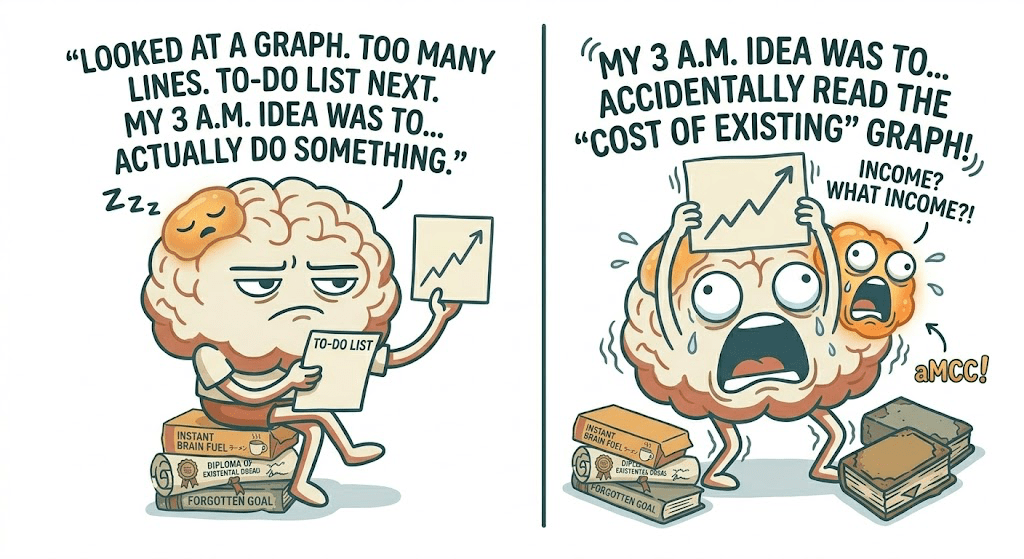
And here is the diabolical catch — the moment you start enjoying something that used to be hard, it stops counting. Your aMCC does not care about effort. The moment the resistance disappears, so does the growth.
Andrew Huberman explains this with ice baths in his conversation with David Goggins. If you hated cold water and got in anyway, your aMCC grew. But the moment it becomes a routine you look forward to — a habit you mention at dinner, a thing you have a Spotify playlist for — your aMCC has already moved on. It is looking for the next thing that makes you want to say no.
Your brain runs a subscription model where the price goes up every time you get comfortable.
This is the most diabolical piece of product design I have ever encountered, and I say that as someone who has used Indian Railways ticket booking.
Why I watched until 1:15pm
The reason this clip kept me going was not Goggins, though Goggins is genuinely impressive in a way that makes you quietly question your own choices.
The reason was this: I kept thinking about people I know who have a quality I could never name. Not loud people. Not the ones with motivational quotes in their LinkedIn bio. The quiet ones. The ones who just keep going when things get bad. Who seem to draw from some reservoir nobody else can find.
I always assumed this was personality. Genetics. Something you either had or did not.
But what Huberman was describing was an organ. A physical structure in the brain that you build, the same way you build anything — by repeatedly doing the thing that is hardest to do.
And the terrifying corollary: if you have not been doing that, it has been quietly shrinking this whole time.
Goggins had never heard of the aMCC before this conversation. When Huberman explained what grows it, Goggins simply said: that is how I have lived my entire life.
He did not sound surprised. He sounded like someone who had been doing the experiment for thirty years without knowing it had a name.
The hack is that there is not one
At this point I was expecting Huberman to hand me a protocol. A stack. A morning routine with six steps and a cold plunge.
He did not.
Because the entire point of the aMCC is that it cannot be hacked. A framework is comfortable. The aMCC hates comfortable. The comfort of a structured plan is precisely the thing it runs away from.
The only input it recognises is: you do not want to do this, and you are doing it anyway.
Mike Tyson — who said things on the Joe Rogan Experience that most people spend years in therapy arriving at — put it better than any peer-reviewed paper:
“Discipline is doing what you hate to do, but do it like you love it.”
— Mike Tyson, JRE #1532
The man has never read a study on the aMCC. He just built one.
That is it. The blog could end here and nothing of value would be lost.
So
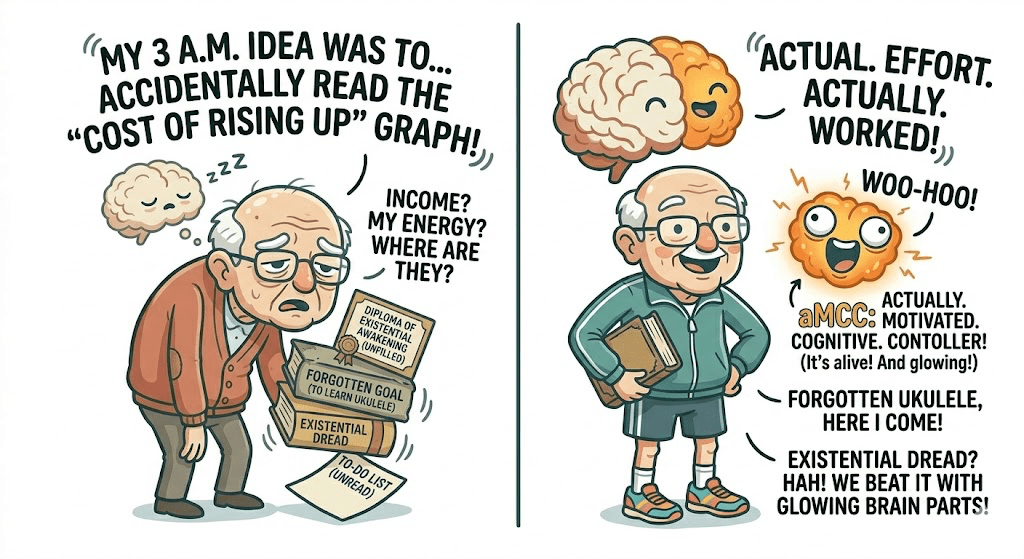
You have two of these, by the way. One on each side of your brain. They came standard. No upgrade required, no waitlist, no premium tier.
Everyone has them. The question was never whether you have willpower.
The question is what you have been feeding it.
And if the honest answer is mostly comfortable things — things you have long since stopped struggling with, things you are actually quite good at now and sort of enjoy —
You know what to do.
Even if you really, really do not want to.
Especially then.
¹ Andrew Huberman is a neuroscientist at Stanford. David Goggins is a retired Navy SEAL who has apparently been running this experiment on himself since 1990, completely unaware that neuroscience would eventually catch up and prove him right.
Sources
- Touroutoglou et al. (2020). The tenacious brain: How the anterior mid-cingulate contributes to achieving goals. Cortex, 123, 12–29.
- Sun et al. (2016). Youthful brains in older adults. Journal of Neuroscience, 36(37), 9659–9668.
- Garo-Pascual et al. (2023). Brain structure and phenotypic profile of superagers. The Lancet Healthy Longevity.
- Katsumi et al. (2022). Structural integrity of the aMCC in SuperAging. Brain Communications.
- Huberman Lab Podcast with David Goggins (2024).
 Too Much Kaapi, Too Many Tabs
Leave a comment